
The Clean Fuel Regulations just crossed the line from "build credits when you can" to "deliver real, incremental low-carbon fuel, now." That shift is reshaping where capital flows, and the communities that own the projects are the ones positioned to win.
For the first three years of Canada's Clean Fuel Regulations (CFR), fuel suppliers could lean heavily on banked credits to meet their obligations. That cushion is gone. 2026 is the first compliance year that requires "incremental" credit creation, meaning the easy baseline credits have run out and six new fuel pathways are now needed just to keep the market in balance. In plain terms, the regulation has stopped rewarding intentions and started demanding molecules.
That is a profound change in the kind of project that gets financed. When credits were abundant, a developer could promise future low-carbon fuel and trade on the paper. Now the value sits with whoever can actually produce renewable natural gas, green hydrogen, or low-carbon methanol and put it into the system. Production beats promises, and production happens on the land, in the communities Solum is built to serve.
The demand signal is now backed by dollars
Policy without money is a wish. This year it comes with both. Starting in January 2026, a 370 million dollar federal biofuel production incentive began flowing to Canadian biodiesel and renewable diesel producers, paired with proposed CFR amendments that would create longer-term demand for domestically produced fuel, likely through domestic-content requirements or a credit multiplier. After a consultation that ran through January, Ottawa is signalling clearly that it wants the fuel made here, not imported.
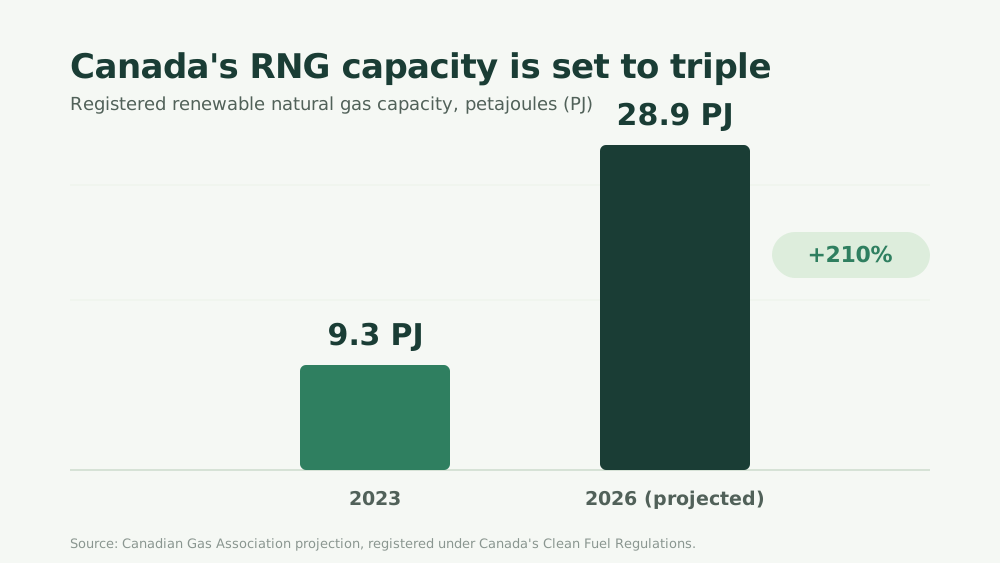
The market has already responded. RNG was the standout performer under the regulation, with registered volumes climbing 417 percent in a single year and capacity on track to roughly triple between 2023 and 2026, as the chart above shows. For a developer turning forestry and agricultural residue into RNG and methanol, feedstock that would otherwise rot or burn, the regulatory and financial tailwinds are now pointing the same direction at the same time.
When credits were easy, the winners were the fastest traders. Now that fuel has to be real, the winners are the people who can build and run the plant, and keep the value where the feedstock grows.
Indigenous ownership has moved from principle to balance sheet
The most underreported shift in Canadian energy is who owns it. First Nations and Indigenous communities are now the third-largest collective owners of clean energy assets in the country, behind only government and large utilities. This is not a symbolic stake. In British Columbia, BC Hydro's latest call for power advanced four renewable projects in which First Nations hold 51 percent equity, more than 2 billion dollars of ownership.
That is the model proving out in real time. Not consultation, not a seat at someone else's table, but majority equity, shared governance, and revenue that stays in the community. It is exactly the structure Solum builds around, co-ownership from the first conversation to the final return, and the 2026 data shows it is now the direction the whole sector is moving, not a niche experiment.
What it means for the next project
Put the three threads together and the picture is clear. The CFR now rewards fuel you can actually deliver. Federal money is backing domestic production specifically. And the ownership model that keeps value in host communities has gone from aspiration to multi-billion-dollar reality. The projects best positioned for this moment are the ones that can produce a real low-carbon molecule, on partnered land, with the community as a co-owner rather than a bystander.
That is the thesis Solum was founded on, green hydrogen, RNG, and biomass methanol developed with First Nations as true co-owners, from seeding to operations. In 2026, the policy and the capital finally caught up to it. The question for every developer, investor, and community this year is no longer whether clean fuel will be built in Canada. It is who will own it.
Sources
- CCarbon, Unlocking the Future of Canada's Clean Fuel Market
- Waste Dive, Canada explores protectionist biofuel policies
- Waste Dive, Canada's clean fuel program sees 417 percent jump in RNG
- Indigenous Clean Energy, Regenerative Energy National Survey 2026
- Province of B.C., Strong response to 2025 call for power