
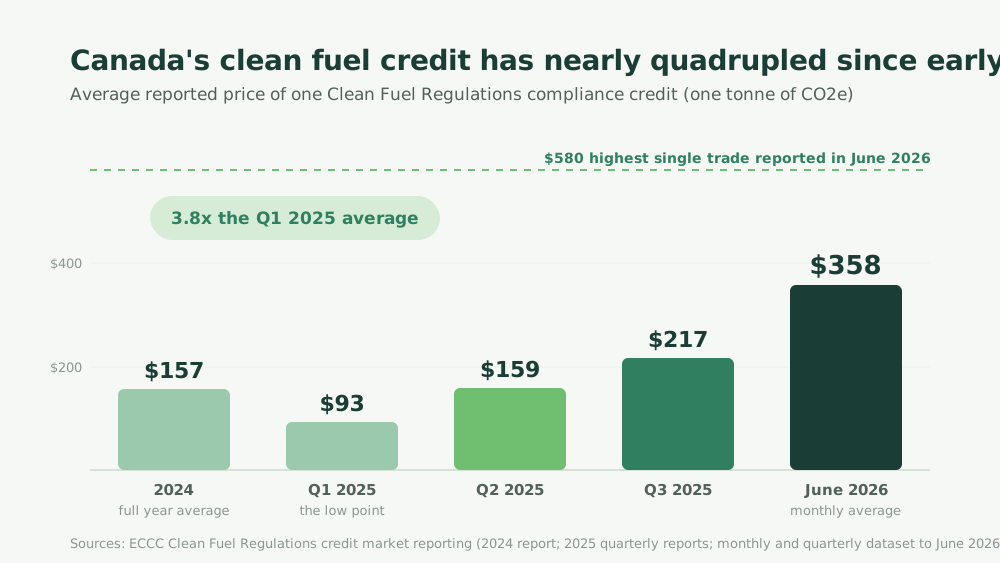
Environment and Climate Change Canada has published its Clean Fuel Regulations compliance credit market dataset through June 2026, and it contains the number every clean fuel developer in this country should be reading. The average price of a CFR credit in June was $358.18. The highest single reported trade was $580. Eighteen months earlier, in the first quarter of 2025, the average was $93.08. The instrument that underwrites low-carbon fuel in Canada has nearly quadrupled, in public, one reported transaction at a time.
The climb is not a spike. ECCC's own quarterly reporting shows the market moving through $159.20 in the second quarter of 2025 and $216.65 in the third. Market participants reported federal credits crossing $400 for the first time in early March 2026. The mechanics behind it are not mysterious. The carbon intensity benchmark that fuel suppliers must meet tightens every year through 2030, while the supply of low-carbon fuel has not kept up. For the 2024 compliance period, ECCC estimated roughly 12.3 million tonnes of deficits against about 8 million credits in the reported categories. When obligation outruns supply, price does the rest.
The credit is now a revenue line, not a rounding error
At $93 a credit, a developer models the CFR as a modest sweetener and finances the project on the fuel. At $358, the arithmetic inverts. For renewable natural gas in particular, which ECCC reporting put at an average carbon intensity of about 7 gCO2e per megajoule in 2024, each unit of fuel generates an unusually large number of credits relative to its energy content. That means a well-sited RNG or biomethanol plant now has two revenue streams of comparable weight, and the second one has moved by a factor of nearly four while everyone was arguing about the first.
That is what makes this a development story rather than a trading story. The projects that will supply this market are not built yet. Canada's 2026 biogas and RNG market report counts 26 RNG projects under development against nearly 300 existing facilities producing about 32 petajoules. The credit price is the market saying, plainly, that it needs more.
A price this strong is a signal, not a guarantee. It says the supply is short. It does not say it will stay short, or that this price will hold.
Read the number honestly
Anyone using a $358 credit to justify a project should also read the risk in it. Credit prices in a compliance market are set by policy as much as by supply, and the policy is in motion. ECCC has consulted on targeted amendments to the Clean Fuel Regulations, including the domestic content and credit multiplier options we wrote about in July, and a compliance fund sets a ceiling that rises on a schedule rather than with the market. A project that only works at today's credit price is a bet on a policy staying still. A project that works on the fuel, with the credit as genuine upside, is a business. Solum builds the second kind.
Who holds the upside
Here is the part that gets skipped. When the credit was worth $93, the question of who owned the equity in a clean fuel plant was largely a question of principle. At $358, it is a question of where several hundred dollars per tonne of avoided emissions actually lands, every year, for the operating life of the asset. Ownership structure is no longer a values statement appended to a financial model. It is the financial model.
Solum develops with First Nations as co-owners, as a starting condition rather than a late accommodation. The forestry residue that feeds our renewable natural gas and biomass methanol work comes from on and near the traditional territories of the communities that steward these lands. A plant that converts that residue into fuel now carries a second revenue stream that has repriced sharply upward. If the ownership is set on day one, that upside compounds where the feedstock came from. If it is set later, it will already have gone somewhere else.
The June dataset is one month of reported trades and it should be read as such. But the direction of the last six quarters is not ambiguous, and the projects capable of answering it are still on paper. The right response is not to chase the price. It is to build the supply, and to decide now, before the concrete is poured, who owns it.
Sources
- Canadian Biogas Association, CFR Compliance Credit Market Dataset, reporting ECCC's monthly and quarterly dataset to June 2026 (June average $358.18, maximum $580).
- Environment and Climate Change Canada, Clean Fuel Regulations 2025 Quarterly Credit Market Report Q1, via cCarbon (Q1 2025 average $93.08; Q2 2025 $159.20; Q3 2025 $216.65; 2024 average $157.21).
- cCarbon, Canada's Clean Fuel Credit Market in 2024 (2024 deficits and RNG carbon intensity).
- 7Gen, Canada's CFR Credits Hit Historic $400 Milestone (March 5, 2026).
- Canadian Biogas Association, 2026 Canadian Biogas and RNG Market Report.
- Environment and Climate Change Canada, Targeted amendments to the Clean Fuel Regulations.
- Solum Energy, Canadian ethanol is now 70 percent imported. The fix Ottawa promised shouldn't stop at corn.