
British Columbia and Alberta may already contain most of the pieces of a regional renewable fuels industry. That does not mean the industry exists. The harder question is whether the biomass, infrastructure, ports, and policy can be organized into pathways credible enough to build.
The forest sector creates the feedstock automatically. British Columbia generates more than seven million cubic metres of forestry residue every year, much of it open-burned in slash piles or left to decay in cutblocks. Alberta's boreal forest covers roughly 381,000 square kilometres, about 60 percent of the province, and its mills produce millions of tonnes of sawdust, bark, and harvest slash. Open burning releases carbon with zero economic return. Together these two provinces hold one of the largest untapped biomass platforms in North America. The coordination problem is not scarcity. It is converting that waste into fuel.
The platform already exists
This is not a metaphor. It is a description of infrastructure already in the ground. Prince George anchors the BC Interior node, with two operating pulp mills, Northwood and the Prince George Pulp and Paper Mill, carrying combined cogeneration capacity above 60 megawatts. Arbios Biotech has completed the world's largest hydrothermal liquefaction facility in the city, Expander Energy is running gasification feasibility work nearby, and Canfor Pulp has provincial funding to convert wood waste into renewable energy. It is the most industrially active biomass node in Canada right now.
The Alberta Industrial Heartland northeast of Edmonton is a different kind of platform. It is already Canada's largest hydrogen-producing region. Air Products brought a hydrogen liquefaction facility with carbon capture into production in 2025, designed for up to 1,500 tonnes of hydrogen per day with more than 90 percent of emissions captured. The Alberta Carbon Trunk Line has operated since 2020, and Imperial Oil's Strathcona renewable diesel complex began commercial production in mid-2025, producing over one billion litres a year. Connecting these interior platforms to Pacific markets is the Port of Prince Rupert, where the 1.35 billion dollar Ridley Island Energy Export Facility is set to complete marine infrastructure in 2026 with capacity for methanol. The port moved 26.3 million tonnes of cargo in 2025, a 14 percent increase, and has signed a green shipping corridor agreement linking it to buyers in Asia and the Middle East.
The platform exists. The industry does not, yet. Methanol is useful because it turns that platform into a concrete test.
Two pathways, matched to each region
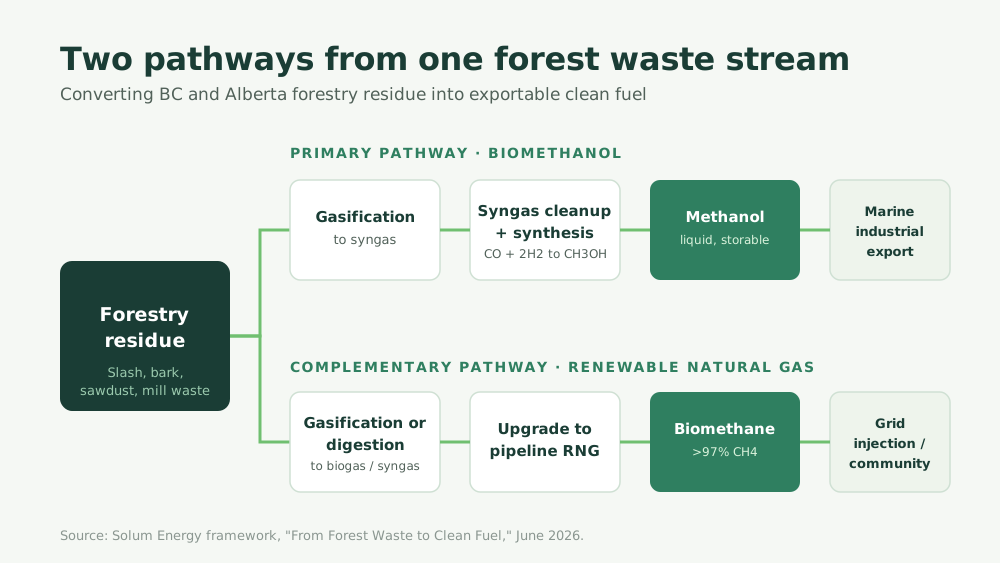
The pathway has to fit the region, and BC and Alberta are not the same. BC's strength is biomass. Its Interior holds dense networks of forestry residue, pulp infrastructure, cogeneration, rail, and skilled process-industry labour. The most credible BC pathway is biomethanol: woody residue is dried and sized, gasified into syngas, cleaned, and synthesized into methanol, a liquid, storable, exportable fuel. That same biomass can also be converted to renewable natural gas, either through gasification and methanation or through anaerobic digestion of wetter inputs, then upgraded to pipeline quality and injected into the existing gas grid at a lower capital entry point than methanol. Solum's Williams Lake RNG project and Vancouver Island biomethanol work show both pathways are already active in the field.
Alberta begins differently. It lacks comparable forestry biomass in its heartland but holds large-scale hydrogen production and world-class carbon capture. Its most credible route is blue methanol: hydrogen from natural gas with carbon captured and stored, combined with a CO2 source to synthesize methanol for export. A combined provincial model is also possible, with BC biomethanol and Alberta blue methanol both moving by rail to Prince Rupert for blending and export. The carbon intensities and risks differ, but the infrastructure and the end customer are shared.
Scale, revenue, and the discipline it requires
Scale is a relationship, not a number. A minimum-efficient biomethanol facility needs roughly 200,000 to 500,000 tonnes of dry biomass a year, which sets a catchment radius of about 75 to 150 kilometres by road or rail. Too small and the fixed costs of gasification and synthesis cannot be recovered. Too large and the plant competes against itself for feedstock. A hub-and-spoke model, with secondary nodes feeding a central conversion facility, is a credible answer in both provinces.
The revenue stack is real but not automatic. It draws on the BC Low Carbon Fuel Standard, among the highest-value such markets in North America, which since April 2025 prefers Canadian-produced fuels. It adds Canada's Clean Fuel Regulations, operational since July 2023 and requiring a 15 percent carbon-intensity reduction by 2030, alongside federal Investment Tax Credits, Natural Resources Canada's Clean Fuels Fund, and Emissions Reduction Alberta, which announced 28 million dollars in February 2026 for forestry and agricultural waste conversion. These incentives are genuine, but each requires independently verified lifecycle carbon intensity, durable policy, and enforceable contracts that projects routinely underestimate.
That is why the first project matters so much. Western Canada has watched promising efforts stall, from Parkland's shelved 600 million dollar Burnaby expansion to the Kalama methanol project, which showed that land, ports, and investment promises are not enough without a credible emissions profile and community legitimacy. A disciplined first facility has to prove reliable contracted feedstock, an independently verified carbon intensity, integration with existing sites and rail rather than greenfield everything, real offtake contracts rather than letters of intent, and First Nations co-ownership formalized before financial close rather than added as an afterthought. Public legitimacy and commercial financeability are not separate concerns. A project that lacks community acceptance is commercially fragile.
Very few regions in the world hold biomass at scale, industrial infrastructure, carbon capture expertise, clean power, the right rail corridors, and port capacity positioned exactly where a maritime fuel transition is crystallizing. BC and Alberta do, at the same moment. The assets exist. The question is whether the coordination, capital, and institutional discipline to turn them into an operating industry can be assembled before the window of demand, policy, and infrastructure timing narrows. The framework exists. The work begins now.
This article distills Solum Energy's June 2026 framework, "What Does It Take to Build a Regional Renewable Fuels Industry? The Case for British Columbia and Alberta," by Alan Kneisz. It is a framework analysis, not a feasibility study or investment recommendation.