On July 14, LNG Canada offered five First Nations the chance to buy the largest liquefied natural gas storage tank in the country, a $1 billion asset planned for its Phase 2 expansion, and lease it back for the operating life of the project. That structure has a quiet significance far beyond Kitimat. It is a third route into ownership, and it changes what co-ownership can look like for every energy project in Canada, including clean fuel.
The details, reported by Black Press Media, are worth reading closely. The Gitga'at First Nation, Gitxaala Nation, Haisla Nation, Kitselas First Nation, and Kitsumkalum, acting together through the MNT Investments limited partnership, would purchase the 225,000 cubic metre tank, the largest in Canada, and lease it back to LNG Canada. The operator keeps responsibility for running and maintaining it. The nations hold title to a hard asset at the centre of the facility and collect lease revenue for decades. The deal proceeds only if Phase 2 gets a positive final investment decision, expected by the end of 2026.
Three routes into ownership
Until recently, Indigenous equity in major energy infrastructure came in two main forms. The Canada Energy Regulator's February 2026 market snapshot maps both. The first is buying into assets that are already operating, where steady revenue makes loans easier to secure. That is how Indigenous communities have acquired stakes in more than 5,000 kilometres of operating pipelines since 2021, including the 38 nations that bought 12.5 percent of the Westcoast natural gas system in 2025 with a $400 million federal loan guarantee behind them. The second is partnering from day one of development, the model behind Cedar LNG, where the Haisla Nation holds majority ownership of a project it helped shape from the start.
The tank deal adds a third: own a discrete piece of infrastructure inside someone else's project, and lease it back. It sits between the other two on the risk spectrum. The nations do not carry the full development risk of the whole facility, but they are not waiting years for an operating asset to change hands either. They hold title to one well-defined, revenue-producing asset with a creditworthy tenant. It is the kind of structure lenders understand instantly.
If five nations can own the largest storage tank in Canada, nations can own the digesters, gasifiers, and electrolyzers of the clean fuel plants coming next.
The financing ladder behind it
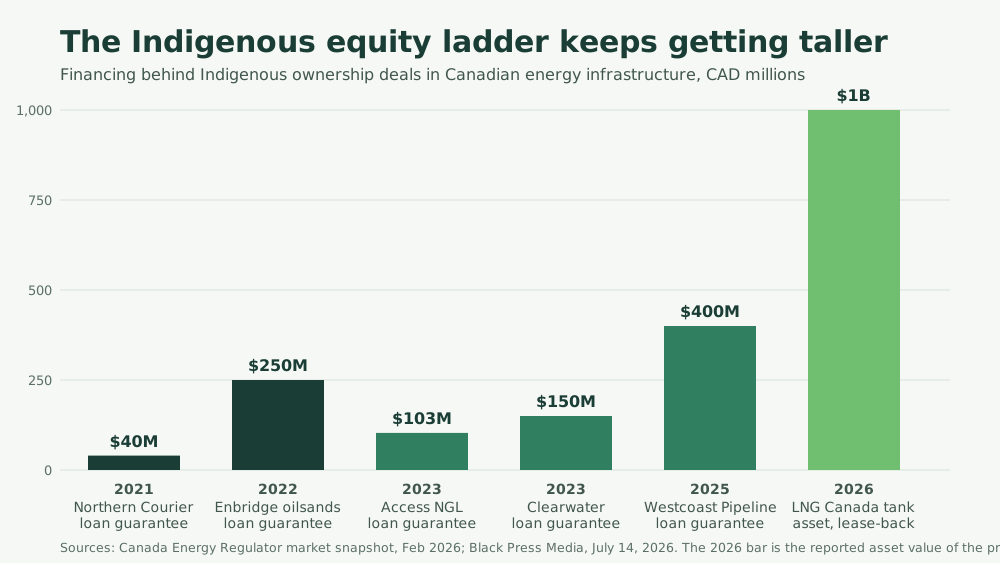
None of this happens without the financing machinery that has been assembled over the past five years, and the chart above shows how quickly it has scaled. A $40 million provincial loan guarantee backed the Northern Courier pipeline deal in 2021. By 2022 the Enbridge oilsands partnership carried a $250 million guarantee. The federal Indigenous Loan Guarantee Program, launched in 2024, wrote a $400 million guarantee for the Westcoast deal in 2025 and can now back individual deals up to $1 billion. Alberta, Saskatchewan, Ontario, Manitoba, and British Columbia all run their own programs. The ladder now reaches high enough that a $1 billion asset purchase by five nations is a financeable proposition rather than a headline aspiration.
What this means for clean fuel
Solum builds green hydrogen, renewable natural gas, and biomass methanol projects with First Nations as co-owners, as a principle of how we structure projects rather than an add-on negotiated later. What the tank deal confirms is that the toolbox for doing this is now wide enough to fit the asset. Day-one development equity suits a nation that wants a governing stake in a new plant. A buy-in to an operating facility suits a nation that wants proven cash flow. And an own-and-lease-back on a discrete asset, a digester, a storage and loadout facility, a rail transload, suits a nation that wants bounded risk and long-term lease income from infrastructure on its territory.
Clean fuel projects are smaller than LNG megaprojects, which makes them a natural fit for these structures, not a stretch. The guarantee programs reach down to the $20 million scale. The partnership models are tested. The precedents are now public. The task for developers like us is to bring these structures to the table at the start, matched to what each community actually wants, instead of asking communities to fit one template.
The final investment decision on Phase 2 will come in its own time. The structure it introduced is already here, and we expect to see it again soon, on projects measured in megawatts and tonnes of clean fuel rather than millions of tonnes of LNG.
Sources
- Black Press Media, 5 First Nations ink deal for ownership stake in part of LNG Canada Phase 2 (July 14, 2026).
- Canada Energy Regulator, Market Snapshot: Growing Indigenous ownership in Canadian pipelines and LNG facilities (February 11, 2026).
- Natural Resources Canada, Canada invests in clean energy in Alberta and Saskatchewan (July 4, 2026).
- Solum Energy, Three deals, ten days: how First Nations are financing ownership.