
Twelve days apart, British Columbia's forest sector made two moves that look unrelated and are not. Both are about getting wood to move. Neither answers the question that decides whether that helps: who buys what is left over.
On September 9, fifteen organizations from across the forest sector, First Nations included, released a joint letter telling Premier David Eby that the sector is at a breaking point. On September 16, the Province named its first candidate area for a proposed Working Forest Landscape Model, in the Campbell River region, chosen in partnership with the Na̲nwak̲olas Council and four of its member Nations.
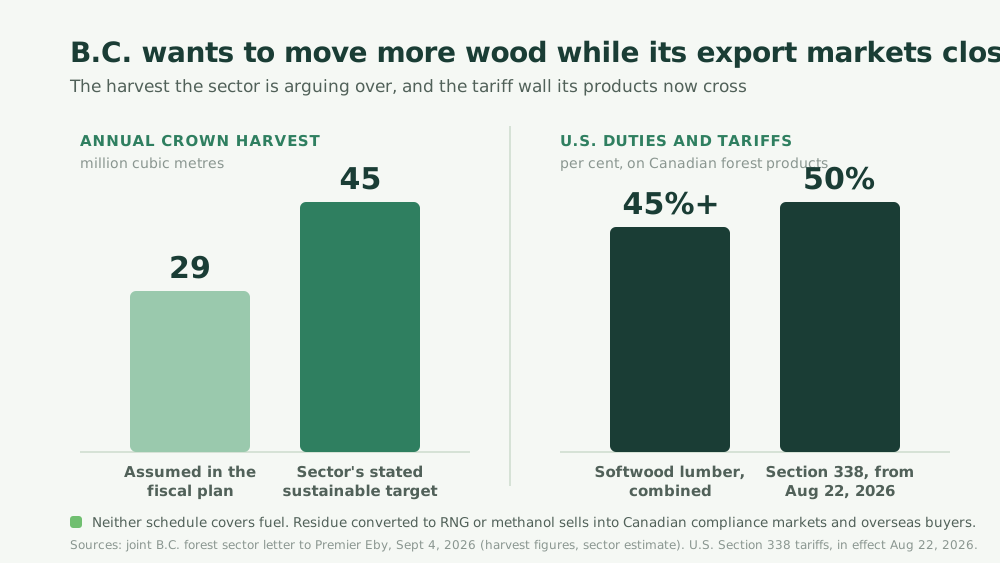
The letter is blunt about the arithmetic. The Province's fiscal plan assumes a Crown harvest of roughly 29 million cubic metres a year, and the signatories argue that with faster permitting and lower delivered costs B.C. could work toward about 45 million. They asked for a Forestry Crisis Action Group run out of the Premier's Office, a freeze on new provincial fees, and a permitting and fibre triage process staffed with industry and First Nations. Whether those are the right measures is a live debate. The pressure behind them is not. Canadian softwood lumber already carries combined United States duties and tariffs above 45 percent, and on August 22 new Section 338 tariffs of 50 percent took effect across a much wider list, plywood, engineered wood, pulp and paper among them.
The residue chain lost a buyer before the tariffs arrived
Canfor's decision in July to permanently close the Northwood pulp mill in Prince George, ending roughly 300,000 tonnes a year of northern bleached softwood kraft and affecting about 300 workers, was not a tariff story. The company's own explanation describes a loop: a shortage of economic fibre closed and curtailed sawmills, fewer sawmills meant dramatically fewer chips, and a pulp mill without chips cannot run. Domtar idled its Howe Sound mill and the associated Bayview chipping facility in August.
Pulp mills are the main customer for sawmill residuals, the chips, sawdust, shavings and bark produced alongside the lumber. When that customer leaves a region, the residue does not stop existing. It stops being worth anything.
More wood moving through the system only helps if every stream coming out the other end has somewhere to go.
What a fuel plant does to that equation
This is the part Solum works on. Forestry residue is feedstock for renewable natural gas and for biomass methanol. A conversion plant sized for residue is a second buyer in the same fibre basket as the mills, useful to an integrated sector rather than a competitor to it. Residue that has no outlet is a disposal cost and a wildfire fuel load. Residue with an outlet is a revenue line for whoever owns the plant.
It also sells somewhere else. Fuel made from B.C. residue is not a forest product crossing the softwood line. At home it earns credits under Canada's Clean Fuel Regulations. Abroad it goes to marine, aviation and industrial buyers reached from Canada's Pacific coast. The Section 338 schedule is a long list of forest products. A cargo of methanol headed west is not on it.
Ownership was already in the frame
The other thing worth noticing is who was at the table. The BC First Nations Forestry Council signed the letter alongside the Council of Forest Industries and the United Steelworkers. The Working Forest candidate area was identified in partnership with the Na̲nwak̲olas Council and the Tlowitsis, We Wai Kai, Wei Wai Kum and K'ómoks Nations, who are already substantial operators in the regional forest economy through the La-kwa sa muqw Forestry Limited Partnership. Council president Dallas Smith pointed to the Nations' experience with spatial planning and tenuring as what they bring to the work.
That is not consultation bolted onto a provincial process. It is Nations participating as principals in it. Solum's approach to clean fuel starts from the same premise. We build with First Nations as co-owners from the development stage, because the communities whose territory a residue supply comes from should hold equity in the plant that converts it.
Nothing about the Campbell River announcement is settled. The Province has been clear it is an exploration phase, with analysis still to come and no decision yet on how the land base will be managed. But whatever shape the zones take, the residue inside them will need somewhere to go.
B.C. has spent this fortnight arguing about how to get logs moving again. It is the right argument. The quieter follow-on question is just as decisive: when the logs are moving, what happens to the part of the tree that never becomes lumber? Build the outlet and it becomes fuel and revenue on the Canadian side of the tariff line. Leave it and it becomes a pile.
Sources
- Prince George Daily News, B.C.'s forest sector organizations call for urgent action to help industry, full text of the joint letter to Premier Eby dated September 4, released September 9, 2026.
- CBC News, Industry leaders warn B.C.'s forestry sector is on the verge of collapse, call on province to act (September 2026).
- Victoria News, 'No more band-aids:' province chooses Campbell River areas for Working Forest Landscape Model (September 16, 2026).
- Province of British Columbia, First candidate area announced for Working Forest Landscape Model (September 2026).
- Canfor, Canfor announces closure of Northwood Pulp Mill (July 14, 2026).
- Davis Wright Tremaine, Fifty Percent Section 338 Tariffs on Many Canadian Goods Effective August 22 (August 2026).
- Solum Energy, The forest is the feedstock: building a regional clean fuel industry in BC and Alberta.