
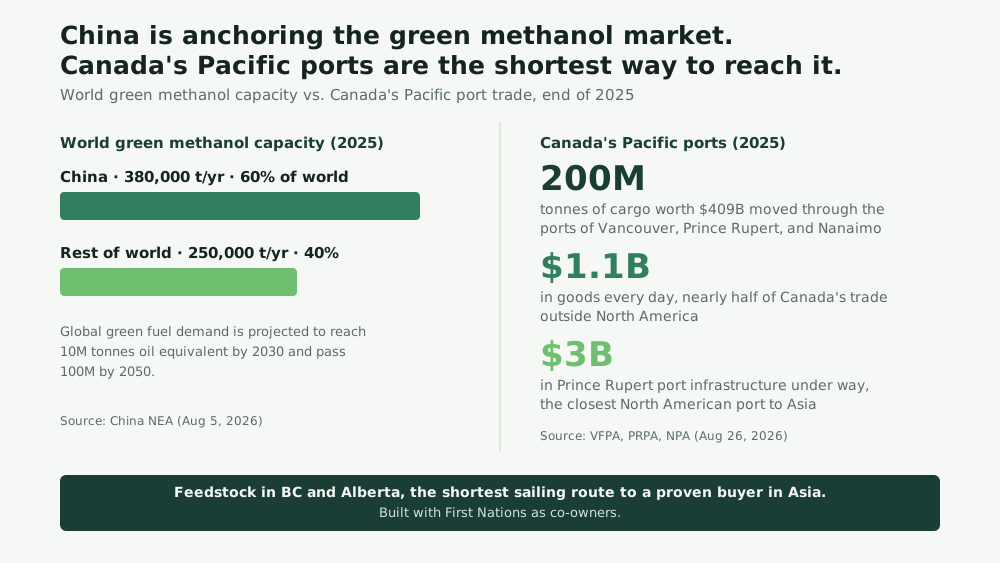
On August 5, China's National Energy Administration published the country's first Green Fuel Development Report. It confirmed that China closed 2025 with about 8 million tonnes of oil equivalent per year of green fuel production capacity, including 380,000 tonnes of green methanol, which is roughly 60 percent of the world's total. Three weeks later, on August 26, the operators of Vancouver, Prince Rupert, and Nanaimo released their own numbers: nearly half of everything Canada trades outside North America already moves through those three ports, and Prince Rupert is the closest port in North America to Asia. Read side by side, the two reports describe the same trade from opposite ends. China has just shown, at industrial scale, that there is a real buyer for green methanol. Canada holds the shortest sailing distance to that buyer, and BC and Alberta hold the feedstock.
A demand signal, not a race
China's Green Fuel Development Report 2026 is useful precisely because it is not a forecast. It is a count of methanol, ammonia, and aviation fuel already produced under real offtake agreements with shipping and aviation buyers. The same report projects global green fuel demand will reach about 10 million tonnes of oil equivalent by 2030 and pass 100 million by 2050. That matters for one reason: buyers are already paying for certified low-carbon methanol at a scale that justifies building a plant, not just studying one. A market that size will not stay concentrated in one country. It needs supply from wherever the feedstock and the shipping lanes line up.
The short route to the buyer
That is where BC's coast comes in. The Economic Impact of West Coast Ports study, released by the Vancouver Fraser, Prince Rupert, and Nanaimo port authorities, found the three ports handled 200 million tonnes of cargo in 2025, worth 409 billion dollars, moving 1.1 billion dollars in goods every day. Prince Rupert anchors the fastest, most reliable supply chain between North America and Asia, with 3 billion dollars in port infrastructure under construction. None of that capacity was built with green methanol in mind. It was built for grain, potash, forestry products, and containers. But a bulk liquid product with a growing Asian buyer base is exactly the cargo that infrastructure is designed to move, and the sailing time to the markets China's report describes is shorter from Prince Rupert than from almost anywhere else on the continent.
Where the fuel comes from
Solum's biomethanol pillar starts with the residue of BC and Alberta's forest economy, the slash, bark, and mill waste the region already produces at scale. That residue now has two live markets on top of the export case: aviation, now that methanol-to-jet has been certified as a sustainable aviation fuel pathway, and the regional platform for biomethanol and RNG we laid out in our framework for BC and Alberta. China's scale-up does not change what Solum builds. It changes the confidence with which anyone can say the market for it is already real, priced, and growing.
China proved there is a buyer. Canada has the coast and the feedstock. What is still being decided is who owns the plant in between.
The port authorities' own study is explicit that this growth runs through the communities along these corridors, noting partnerships with First Nations from procurement to environmental stewardship across all three ports. Solum builds the same way, with First Nations as co-owners as a principle of how a project is structured, not an addition once the financing is settled. A biomethanol plant feeding Pacific export markets is a long-lived, revenue-producing asset, the kind co-ownership is built to hold for decades, not just to open.
None of this is a promise that a Canadian cargo of green methanol clears Prince Rupert next year. It is a read of where the pieces already sit: a verified buyer, a coast built for the trip, and forestry residue that has to go somewhere. The next fortnight will tell us more about how fast that gap closes. For now, the direction is clear enough to build toward.
Sources
- Global Times, China becomes major global supplier of green fuel, with production capacity of 8m TOE in 2025, reporting on the National Energy Administration's China Green Fuel Development Report (2026) (August 5, 2026).
- Vancouver Fraser Port Authority, Prince Rupert Port Authority, and Nanaimo Port Authority, Joint Media Release: Canada's West Coast Ports Are Leading the Way to Doubling Non-US Trade, citing the Economic Impact of West Coast Ports study by InterVISTAS (August 26, 2026).
- Solum Energy, Methanol-to-jet just got certified. That puts biomass methanol on a runway to aviation.
- Solum Energy, The forest is the feedstock: building a regional clean fuel industry in BC and Alberta.