
On June 29, Canada's corn farmers and ethanol producers went public with a demand: deliver, this summer, on a promise Ottawa made last September. The fight is playing out over ethanol right now, but the fix on the table decides how every domestically produced low-carbon fuel in this country competes, not just corn.
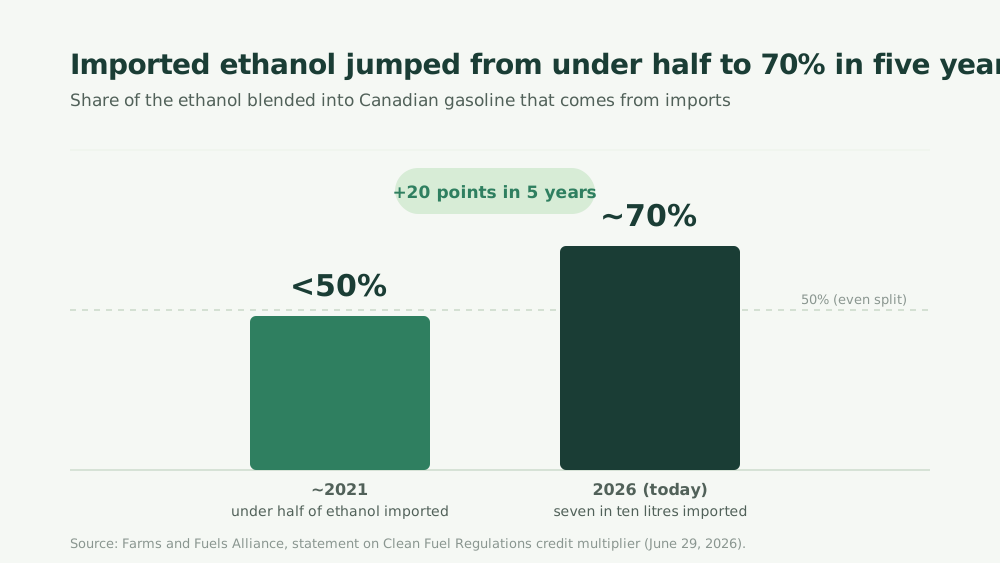
Canada's Farms and Fuels Alliance, which represents corn growers and domestic ethanol producers in Ontario and Quebec, says the numbers have moved fast in the wrong direction. Five years ago, under half of the ethanol blended into Canadian gasoline was imported. Today it is about 70 percent, and rising, even as Canadian producers sit on more than a billion dollars in shovel-ready investment they say they cannot commit without a clearer policy signal. The reason, the Alliance argues, is a subsidy gap. The United States' 45Z Clean Fuel Production Credit hands American ethanol producers support worth up to 36 cents a litre, extended through 2029, and that subsidized fuel earns the same Clean Fuel Regulations credit in Canada as fuel made here. Their ask is specific: a minimum 1.4x credit multiplier for domestically produced ethanol, written into Canada Gazette Part I this summer.
What Ottawa actually promised
The commitment behind that ask is real. On September 5, 2025, the federal government announced it would pursue targeted amendments to the Clean Fuel Regulations specifically to protect the competitiveness of Canada's domestic low-carbon fuel sector. A discussion paper followed, floating two mechanisms: a minimum domestic content requirement, or a credit multiplier that gives fuel made in Canada more credit value than the same fuel imported. The comment period closed January 15, 2026. Draft amendments were expected in Canada Gazette Part I early this year. They have not landed yet, which is exactly what the Farms and Fuels Alliance is now pushing on.
The mechanism is bigger than corn
A credit multiplier does not know the difference between a litre of ethanol and a cubic metre of renewable natural gas. It is a design choice about how much more a domestic molecule is worth than an imported one, and whatever number Ottawa lands on this summer will apply across every fuel pathway registered under the Clean Fuel Regulations, including RNG and biomethanol made from BC and Alberta forestry and waste residue.
That is not a hypothetical concern. When Environment and Climate Change Canada first floated these amendments, the RNG Coalition submitted its own comments and stopped well short of endorsing the credit multiplier approach. Its worry was specific: a multiplier sized around ethanol and diesel economics could dampen demand for RNG rather than support it, unless paired with a corresponding increase in the obligations petroleum suppliers must meet. In other words, the same tool ethanol producers see as a lifeline, gas and biogas producers see as a design problem that has to be solved carefully, not a favour that flows their way automatically.
A credit multiplier calibrated for corn ethanol is not automatically calibrated for waste biomass RNG or biomethanol. The design decision Ottawa makes this summer sets the terms of competition for every domestic fuel pathway at once, not just the one asking loudest.
Why this matters to what we build
Solum's work in BC and Alberta runs on the same underlying premise the Farms and Fuels Alliance is fighting for: that fuel made from Canadian feedstock, on Canadian land, should be worth more under the CFR than fuel shipped in. We laid out the case for that region's forestry waste biomethanol and RNG pathways last month, and the revenue case for that industry leans in part on exactly the kind of durable domestic policy signal this amendment is supposed to provide. A credit multiplier that gets ethanol right and gets gaseous fuels wrong would strengthen one part of Canada's clean fuel sector while leaving another exposed, at the same moment RNG capacity is scaling and forestry-waste projects are moving from framework toward first build.
Ottawa said it would decide this summer. Whichever way the Gazette Part I text lands, it will tell every developer building low-carbon fuel in Canada, not just the ethanol sector, how seriously the government takes its own promise to reward fuel made here.
Sources
- Farms and Fuels Alliance, Farms and Fuels Alliance Calls on Government to Deliver on Clean Fuel Commitment for Canadian Ethanol This Summer (June 29, 2026).
- Waste Dive, Canada explores protectionist biofuel policies, prompting industry pushback (February 10, 2026).
- Environment and Climate Change Canada, Discussion paper to inform the draft targeted amendments, Clean Fuel Regulations.
- Solum Energy, The forest is the feedstock: what it takes to build a regional clean fuel industry in BC and Alberta.