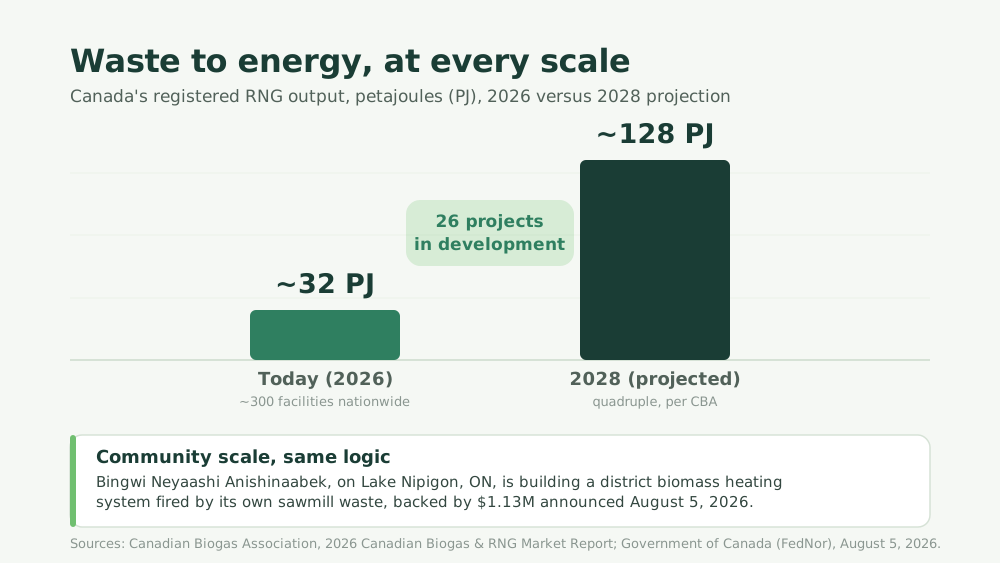
On August 5, the federal government announced $1,129,183 for Bingwi Neyaashi Anishinaabek, a First Nation on the shores of Lake Nipigon in northwestern Ontario, to build a district biomass heating system. The plant will run on wood residue from the community's own sawmill, heating buildings across the community and cutting its reliance on diesel generators. It is a modest project by dollar value. It is worth reading closely anyway, because it is the small end of a pattern showing up at every scale in Canada's clean fuel sector this year.
The funding, delivered through FedNor's Northern Ontario Indigenous Clean Energy Initiative, layers $669,383 in new support on top of $459,800 committed in December 2025. The mechanics are simple. A resource the sawmill used to treat as waste becomes the fuel for a heating system the community owns and runs, replacing diesel that had to be trucked in. Reliable heat, lower emissions, and money that used to leave the community for fuel now stays closer to home.
The same week, at national scale
Within the same fortnight, the Canadian Biogas Association published its 2026 Market Report, and the headline number is the national version of the same story. Canada's renewable natural gas facilities, nearly 300 of them, are producing roughly 32 petajoules of low-carbon energy from organic waste today. With 26 new RNG projects now in development, the association expects that output to quadruple by 2028. Different feedstocks (farm manure, landfill gas, wastewater, and increasingly wood residue), different provinces, but the same underlying shift: material that used to be burned off, landfilled, or left to rot is being turned into an energy asset with an owner attached.
Two pathways, one feedstock
It matters to be precise here, because Bingwi Neyaashi Anishinaabek's project and the national RNG buildout are not literally the same technology. The community's system burns wood residue directly for heat. Most registered RNG comes from anaerobic digestion of organic waste into pipeline-grade gas, a chemical process rather than combustion. Forestry residue specifically can go either way. It can be burned for local heat, as in Thunder Bay, or it can be gasified and upgraded into pipeline-grade gas or biomethanol, a route that reaches markets a heating plant cannot: transport fuel, utility blending, and eventually aviation.
The technology differs by scale. The ownership question does not. Whoever holds title to the plant holds the value of the waste stream, whether that plant heats forty buildings or feeds a pipeline.
That is the throughline connecting a $1.13 million community heating system to a national buildout expected to quadruple in three years. Both are converting a previously discarded resource into a long-lived, revenue-producing asset. The Canada Energy Regulator has already documented Indigenous communities acquiring ownership stakes across pipelines, LNG facilities, and renewable power. Bingwi Neyaashi Anishinaabek's project is that same logic applied to the smallest, most local unit of the clean fuel economy: one community, one sawmill, one heating plant, held outright.
Where Solum sits on that spectrum
Solum's renewable natural gas and biomass methanol projects sit in the middle of that range, above a single building's heating plant and below a national pipeline network. We take the same forestry residue that could heat a community directly and convert it into pipeline-grade fuel at industrial scale, sized for the demand documented in Western Canada's growing fleet of natural gas trucks and laid out in our own framework for a regional clean fuel industry in BC and Alberta. We build these projects with First Nations as co-owners as a starting principle, not a later concession, because the residue we use comes from the land communities have stewarded for generations.
The RNG sector is not going to quadruple by 2028 because of any one project. It will happen because dozens of projects, from a single community's heating plant to industrial gas facilities, get built with someone accountable for the outcome and someone who benefits from it. Bingwi Neyaashi Anishinaabek just showed what that looks like at the smallest scale. The national numbers say the rest of the country is about to find out what it looks like at the largest.
Sources
- Government of Canada (FedNor), Government of Canada investing over $1 million in Indigenous-led clean energy in northwestern Ontario (August 5, 2026).
- Canadian Biogas Association, 2026 Canadian Biogas & RNG Market Report.
- Canada Energy Regulator, Market Snapshot: Growing Indigenous ownership in Canadian pipelines and LNG facilities (February 11, 2026).
- Solum Energy, The forest is the feedstock: building a regional clean fuel industry in BC and Alberta.