
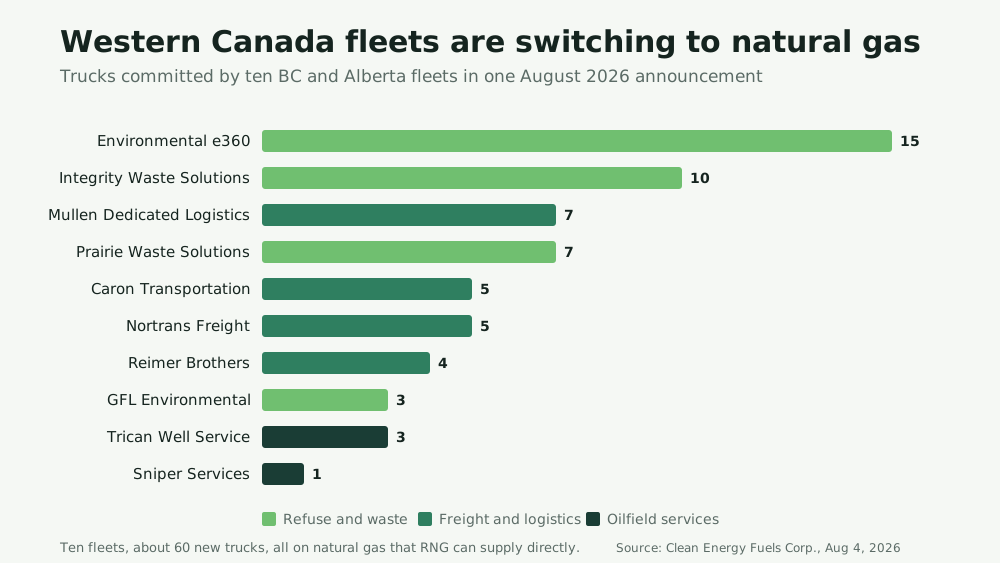
On August 4, a set of new fueling and truck agreements was announced across British Columbia and Alberta. Ten fleets are adding roughly 60 natural gas trucks between them, from refuse collection in Chilliwack to heavy haulers in the Alberta oil patch. To be precise about that number, it is the total newly committed across the ten fleets named in this one announcement, orders placed or deployments beginning now. It is not a monthly or annual rate, and not a count of every natural gas truck already running in the two provinces. No delivery timeline was published.
Those trucks burn compressed natural gas today. The reason it matters for anyone building clean fuel in Canada is that the same trucks, the same engines, and the same stations run on renewable natural gas with nothing changed.
The switch is being driven by economics and by an engine. The distributor behind these stations, working with Tourmaline, has been building out compressed natural gas fueling in Edmonton, Calgary, Kamloops, Grande Prairie, and now Chilliwack, and puts the fuel cost at 40 to 50 percent below diesel. Just as important, the arrival of the Cummins X15N, a 15 litre natural gas engine, has closed much of the performance gap that kept the heaviest, highest mileage trucks on diesel. Fleets in freight, logistics, refuse, and oilfield services all appear in the announcement. Nortrans, a British Columbia carrier, has put more than three million dollars into natural gas tractors over two years, the largest capital investment in its 35 year history.
The molecule is the point
Renewable natural gas is chemically interchangeable with the fossil kind. It is captured from landfills, farms, wastewater, and, increasingly, wood waste, cleaned to pipeline standard, and dropped into the same infrastructure. A truck fueling at one of these stations cannot tell the difference, and neither can the engine. That is what makes this buildout worth watching. Every compressed natural gas truck rolling onto a BC or Alberta highway is a vehicle that can run on renewable natural gas the day the supply is there. The infrastructure going in now is, in effect, a distribution network for a low-carbon fuel that Canada has only begun to produce at scale.
Demand is arriving where the credits are
Canada's Clean Fuel Regulations reward low-carbon fuels used in transportation, and renewable natural gas used to move freight is one of the cleaner options on the menu. The demand signals are stacking up. Away from the highway, FortisBC now designates 3.5 percent of every customer's gas as renewable natural gas, up from one percent, on the way to a provincial goal of 15 percent renewable gas by 2030. Utilities pulling on one end and heavy transport pulling on the other is the kind of durable, policy-backed demand that supports the case for building supply. And supply, not demand, is the binding constraint in Canada today.
Where the fuel should come from, and who should own it
This is where Solum's work begins. The companies putting in pumps and buying trucks are building the channel. What they need is fuel, and that is the side of the equation we develop. Our renewable natural gas pillar starts with the residue of the forest economy of British Columbia and Alberta, the slash, bark, and mill waste the region produces at scale. The first commercial wood-waste to renewable natural gas facility in North America is already being built in BC, evidence that the forestry to gas pathway is real and not theoretical. Turn that residue into pipeline quality gas and you can feed both the utility blend and the fuel tank of a refuse truck in Chilliwack.
The stations going in this week are a standing order for a fuel Canada has only begun to produce. The question is who builds the supply, and who owns it.
Solum develops these projects with First Nations as co-owners, as a principle of how a project is structured rather than a concession added at the end. Forestry residue is generated on and near the traditional territories of the communities that steward these lands. A plant that turns that residue into a fuel with a growing market is the kind of long-lived, revenue-producing asset that co-ownership is built to hold. The fleets buying natural gas this week are not waiting for a cleaner version. They are building the demand that makes the cleaner version worth producing.
A fueling station opening in Chilliwack does not read like a clean fuel milestone. But each of these trucks is a potential customer for renewable natural gas, in the two provinces where Solum builds. The pumps are going in. The next job is filling them with fuel made from the forest floor, on projects owned in part by the communities whose land it comes from.
Sources
- Clean Energy Fuels Corp. via Business Wire, Clean Energy Expands Fueling Network as Trucking and Refuse Fleets Across Canada Choose Natural Gas (August 4, 2026). Truck total is the sum of the ten fleet commitments named in the release.
- FortisBC, Renewable Natural Gas: designated blend and program (accessed August 2026).
- Canadian Biomass Magazine, A First for North America: FortisBC, REN Energy to Produce RNG from Wood Waste.
- Canadian Fuels Association, Clean Fuel Regulations.
- Solum Energy, The forest is the feedstock: building a regional clean fuel industry in BC and Alberta.